søndag 29. november 2015

4. Herøy museum

  This museum represent open-air museum or folk museum from 18th century. In this old house you can find actually many exhibits focused on daily life from past times. The main building, which is quite big, has many rooms. So you can see kitchen with many properties which were used (and some of them are so inventive!). How it looked in living room, workroom with tools of shoemaker, also one room is focused on education - old maps, equipment of teacher and pupils. Also bedrooms and collection of clothes you can see in first floor. I think it is very nice museum where is saved big amount of properties.
 We also heard that this place is used for schools - tour guides and workshops. In my country we have similar museums which we called "skanzen". There are many of them and it looks similar to this place. So you can realize, that it does not matter on country, people in Europe had similar style of life and many things are the same.
 In my opinion these places are perfect for children for excursions and having workshops. I remember when I was a pupil we had an excursion in skanzen and we loved it. Because it is real - you can see objects so it is easier to imagine how our ancestry lived. And discovering our roots and our history of our culture is important - and these places offeres learning in attractive way.


Petter Dass Museum in Alstahaug

Day 3, 24.11.2015

After our visit to the International War Cementery in Tjøtta, we went to the Petter Dass Museum in Alstahaug. For everybody who is not known to Petter Dass, I will give a short introduction:
Throughout the ages, Alstahaug has become best known due to such prominent personalities as Petter Dass. He was born in Herøy in 1647 and lived there for the first six years of his life. At the age of 22, Petter Dass returned to Helgeland, first to Vefsn and Nesna, and then to Alstahaug, where he became minister in 1689. He was also writing, and his best-known works are The Trumpet of Nordland and the hymn"Mighty God", to Thy dear Name be given Highest praise". He lived in Alstahaug until his death in 1707.
A little about the museum:
Here you can gain an insight into how the poet-clergyman Petter Dass lived. The grounds accommodate a main building, a storehouse, a cookhouse/scullery, a well house, a chapel and down by the sea a quayside warehouse where boats and tackle help illustrate elements of coastal culture. A guided tour will give you insight into an important part of Norwegian history and culture. Guided tours are available between mid June and mid August. The Petter Dass Museum at Alstahaug is The County of Nordland´s millennium site. The building is designed by the architectural firm Snøhetta AS. This building is the Petter Dass Museum’s main building.


I really like architecture. The museum is built in between the rocks. It fits quite well into the landscape. You really can see the connections between the buildings and how the architects wanted them to interact with each other.


The International War Cementery in Tjøtta

Day 3, 24.11.2015

On our previous trip of our third module of the Adventure Knowlegde course we went to Sandnessjøen. We arrived very late in the evening on Monday the 23rd of November 2015. 
On the next day we went by bus to the International War Cementery on Tjøtta. It is actually a Russian War Cemetery. TThis cemetery was devoted to all of those who perished at the sinking of the troop transport ship "Rigel" on November 27, 1944. The ship sank and altogether 2,457 people perished. The event is considered one of the most significant shipwrecks in the world. The wreck lay partially submerged off the coast of Rosøya island until about 1970, but has now been removed. This cemetery was consecrated in 1970. All the graves are anonymous, but a memorial stone in the form of a cross has been erected on the site.


I can not really describe the feelings I had, when I stood on the ground of a cementery where more than 6,700 dead soldiers are buried. It made me feel terrified to what people are able to do during war and how devastating war is. I hope that I will never experience something like that.

Photo - Adventure Knowledge course 2015!


Bygdemuseum


Bygdemuseum

In the 1960s one man started to collect things from all around Norway and made a collection out of it. Within this collection you can find a lot of things. It includes things from the "normal life" up to school things and many more.
The whole house was moved from Mosjøen to Herøy, where it is now standing. The foodstore is standing on columns because this house has no basement, so the floor would get wet without the columns.
In former times the house was used as the priests hous, where he was living. It is
a really big building and has a lot of different rooms.
The exhibition is seperated in different rooms with different topics.
Our tourguide was really kind and our trip started with a lunch and selfmade scones from him.

The following pictures show you some of the rooms, which you can find:
kitchen/ living room
underwear
hat
typewriter/ office

kitchen
teaching room
 Those are only some of the rooms which you can find within the exhibition. If you are going to see this exhibition, you should arrange enough time. The exhibition is mostly without any text, but you can get a good insight because of all the pictures and the shown exhibits. You can explore a lot in those rooms and if you want you can stay there for ages and you will not explore everything.


Another part of the museum is a little fishermen`s hut. This hut was built by Rich fishermen, which came with their boat to Mosjøen and didn`t want to continue their trip. They than had a little house, to cook, eat and sleep. Up to 4 fishermen were sleeping in those two beds. The hut was just built that the fishermen had all the most important things and that they can have a rest before their next trip.

beds
table for eating and writing
To sum up,one can say that this museum is really nice although you are not speaking Norsk. Everyone will find a place to stop and stare. You can Discover many things and you will not get bored.


Bodin kirke

The Bodin kirke

It is told that this church was built in the year 1240, because coins of this year were found under the floor. The church was rebuilt several times.

This church was very important in former times, because it was the only church where everyone got baptised - until the church in Saltstraumen was built.
Usually the place for getting baptised was in the back of the church - because you have to get baptised first and then you are part of the church community. But the area for getting baptised in Bodin church is in the front.
Some people had to take a risky way for getting baptised and some of them died during that way.
The Bodin church is a catholic church. Because of this reason you can find some crosses within the building.
The Pictures shows one cross, which many people touch and then make a cross on their face. The cross is a symbol for the relationship between god and human beings. The cross is very important for christians.
The candlesticks in Bodin kirke are very special as well.  They were mounted in 1764. Each candlestick has got some inscription. Furthermore, the candles were very expensive - each candle
costed eight cows.  As you can see on the Pictures there are many candles on one candlestick - rich church.


Another proof that the church is quite old are the church doors. One old door was found in a farm. When the people found out that it was part of the former church they restored it and took this door as example to build all the other ones.
Nameshields were fixed at every bench - every family had it`s own bench. Fishermen usually had to stand.
Also the altar was found outside the church. It was used as a stair to get to the toilet which was situated outside. Then some people found out that it is an altar and put it inside the church. Inside the altar is a little note from the bible.
Within the altarpiece are many levels, it is built in barockstyle and it has got many details. The columns of the altarpiece look like stone and after some time flowers where drawn there. In former times the church wasn`t that high, so the top of the altarpiece couldn`t be seen. Now you can see the statue of Christ coming to heaven.
One big part of the altarpiece is the last supper. There you can see that no one is sitting in the front, so there is place for someone. This can be seen as invitation to join the last supper with Jesus. You can also see there a young boy sleeping next to Jesus - it`s John.


"We are sailing in our lives" - Sailing to reach a goal (Christ)

In Bodin church you can find a so called "Churchship". The ship is very important for this part of Norway. It is sailing against the East, because it is told that Christ is going to come back in the East.


Petter Dass and the Petter Dass Museum


After visiting the War Cemetery, we visited the Peter Dass museum. Petter Dass (picture 1) was a poet priest who lived from 1647-1707. He lived from 1689 until his death in Alstahaug, with which he is very connected. The house, in which he lived, is next to the museum (picture 2). Petter Dass has a central role in Norwegian cultural history. He is one of the most important Danish-Norwegian poets of his time. His works are embossed by the nature and the living conditions in northern Norway. Him in honor, the Petter Dass museum was opened in 1966, which is part of the Helgeland museum. The museum is a place of contrasts, because it consists of a new and modern museum (picture 3/4), a parsonage from the 18th century and a medieval church (picture 5). The museum conveys primarily the life story of the poet priest and the wide role which he has for the cultural history of the region. The museum’s building was designed by the renowned architectural firm Snohetta AS. The Petter Dass museum is a very modern building midst of nature. The building itself is slope. If one stand on the top floor, one can see on the one side the church through a glass facade. If one look to the other side (180 degrees), one can see the ocean (picture 6) and forest. It seems, as one could look up in the future. The building is very impressive, because it stands in the middle of a rock (the two sides, where no glass facades are). The museum is very clearly arranged with a TV room, musical elements and precise information about Petter Dass. Although it is surrounded by a rock, it looks very bride and friendly inside the museum, because of the glass facades and the ocean view. I am very impressed about the museum and I have never seen a museum like this before. In my opinion, the combination of modernity and nature is very good and I really like that place. 
Picture 1
https://snl.no/Petter_Dass
Picture 2
 Picture 3
Picture 4
Picture 5
Picture 6

War Cemetery

In the week from the 23rd to the 26th of November, we made a 4 day trip with our course. On the first day, we took the ferry from Bodø to Sandnessjøen. On our second day, the first stop was at a War Cemetery (picture 1), which seemed very unimposing when we arrived. At the first glance, one saw a big grass field, which is fenced by a wall. As we stood on the grass field, we saw that panels were installed on the stone wall. At the other end of the field is a monument (picture 2/3). This war memorial commemorates on the victims of the 27th of November 1944. On this date, the British army attacked a ship with war prisoners by planes - at the same point of the fjord, where the monument is nowadays. Almost all war prisoners died because of this attack. Up to the 70s, the ship was on the coast to commemorate on the attack. After removing the ship, the rudder of the ship was brought to the other side of the fjord and remembers to the disaster. Half of the monument consists of a mass grave of the victims. This can be seen because of the panels at the wall (picture 4/5). The other part of the monument consists of individual graves, which can be recognized because of the small stone tables in the grass (picture 6). Unfortunately, there is not so much known about the graveyard, like about other memorials. Nevertheless, there are two ceremonies to commemorate to the causalities every year. The visit at the War Cemetery was very interesting and for me the most interesting visit of our 4-day-trip. It is horrible what happened because of the war and how many places and cities all over the world were destroyed and attacked. It is a pity that not so much information are known about the visited cemetery. We should talk more about topics like this.


Picture 1
 Picture 2
Picture 3
Picture 4 
Picture 5
Picture 6

International Russian War Cemetery

During World War 2, many prisoners - mainly Soviets - were held in camps in Norway. They had to work hard and were seriously punished, often shot, or died through inllness.
There were many camps around in Nordland; the prisoner's work was very important for that area because they helped building up the infrastructure, and worked in fish and brick factories.

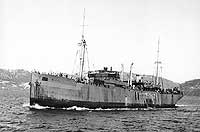
MS Rigel på Vefsnfjorden våren 1941. Foto: Ludvig Vikbakk.

In 1944, British planes attacked the ship "MS Rigel" which was taking thousands of Soviet prisoners south. "MS Rigel" was baldy damaged and about 2500 people died; it is the third biggest incident of all times! 

                                                                                                                                                                                picture 1                                                                                                                                                                                                 


Starting in 1957, "Operation Asphalt" was supposed to collect all dead Soviet prisoners, bring them to Tjotta, and burry them there at one place. In 1953, a piece of land given by the government to place the bodies. There are now burried about 8000 people, mostly unidentified          Russians. This big area is restricted with stone brick walls; on this walls there are boards on which names of the fallen are writen down. 
The place is big, very remote, and far from the city. Only few people know that this places exists and come to visit it. Although it was such a big happening, there is little information to be found. 
In 2013, it had been 60 years since it happened; but there were no ceremonies.


 In my opinion it is a pitty that there is not more information given about this tragic happenings. I was searching the internet but was not able to find someting I could have used. There is supposed to be an interview with a survivor of the Rigel catastrophy on video taken for the 60th anniversary but I sadly could not find a link. 

picture 1: http://www.nrk.no/nordland/60-ar-siden-helvete-1.95615